As we continue to explore Mary’s role in the prayer and worship of the People of God we are faced with an inevitable question – what is liturgy? What function does it have and how does it express the essential attitude of the People of God? Why, at the heart of all, must the Christian be a liturgical being, and the being of the Church an unending liturgical action?
That invaluable little document the YouCat offers a helpful word on liturgy. It teaches that “the most profound origin of the liturgy is God, in whom there is an eternal, heavenly banquet of love – the joy of the Father, the Son, and the Holy Spirit”; that “liturgy is always in the first place communion or fellowship with Jesus Christ. Jesus reveals his passage from death to life and celebrates it with us”; and, finally, that “in all earthly liturgies, Christ himself is the one who celebrates the cosmic liturgy, which encompasses angels and men, the living and the dead, the past, present and future, heaven and earth”. So, the liturgy – the formal and necessary worship which the People of God are bound to offer to the Father, through the Son, in the Holy Spirit – is a participation in the always present heavenly liturgy, an action through which we are inserted into the universal action of Christ the High Priest. Such a liturgical disposition, if we may call it that, begins in the consecration of each one of us as and becoming a never-ending hymn of glory – a doxology, if you will – offered to God. This is who we are called, daily, to be. And this is what we become formally with every liturgical action in which we participate.
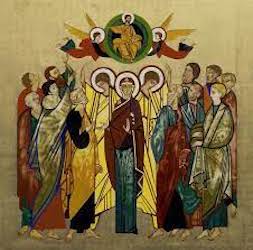
To consider Mary, the Mother of the Church, as a teacher in the celebration of the liturgy is to look into the Church’s first moments of life. At the beginning of the Acts of the Apostles, when the apostles have returned from that moment of farewell with Christ, we learn: When they reached the city they went to the upper room where they were staying; there were Peter and John, James and Andrew, Philip and Thomas, Bartholomew and Matthew, James son of Alphaeus and Simon the Zealot, and Jude son of James. All these joined in continuous prayer, together with several women, including Mary the mother of Jesus, and with his brothers (Acts 1:12-14). This telling text reveals to us the standard practice of the Church, from its very beginning, already a Church in vigil, watching, expecting, anticipating, and marked by a turn to prayer together. It is simply the natural attitude of Christ’s disciples – to be gathered in prayer. And it’s a prayer which is continuous, unceasing, unique and unifying, uniting and unbroken. We do not know what was the prayer in that upper room, in terms of words or phrases, except that it was the common prayer of those who gathered, and with which they felt at home and comfortable. It was the well-honed prayer of faith and practice.
At the centre of this prayerful action sits Mary. We might say that it is her faith which now strengthens those who have been shaken by the most recent events. St Augustine reminds us that before Mary conceived Christ in her womb she had already conceived him in faith: “The attitude of Mary of Nazareth shows us that being comes before doing, and to leave the doing to God in order to be truly as he wants us. It is He who works so many marvels in us. Mary is receptive, but not passive. Because, on the physical level, she receives the power of the Holy Spirit and then gives flesh and blood to the Son of God who forms within her. Thus, on the spiritual level, she accepts the grace and corresponds to it with faith. That is why St Augustine affirms that the Virgin “conceived in her heart before her womb”. She conceived first faith and then the Lord” (Pope Francis, Solemnity of the Immaculate Conception 2014). And indeed, is not one of the most striking images which we have that of the Annunciation, when the Archangel, seemingly creeping into the scene, greets Mary, conceiving Christ the Word in her pondering of Sacred Scripture!
Surely we can rightly say, then, that Mary, she who already had been Temple of the Lord, also accompanied the whole band of believers to that soon to fall other Temple, to pray; a group which again is characterised by formal bonds which reveal the centrality of a formal prayer life: These remained faithful to the teaching of the apostles, to the brotherhood, to the breaking of bread and to the prayers… They went as a body to the Temple every day but met in their houses for the breaking of bread (Acts 2:41-43).
Mary, from the beginning, is already a participant in the Church’s liturgy of being, a liturgy which at the same time forms the Church and reveals her in her faith in prayer-action.
-Part of our series on ‘Mary Most Holy’-
Other posts..
 Our Lady of Bethlehem Abbey, Portglenone