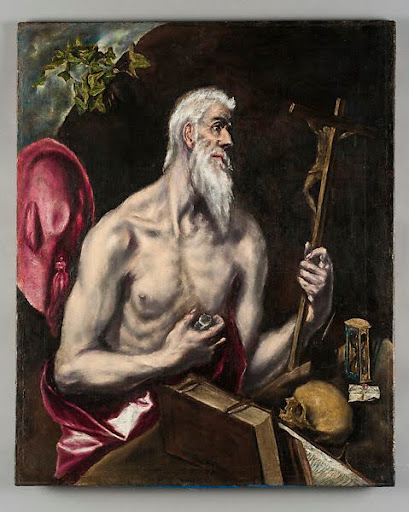
That giant of biblical scholarship, St Jerome, may shock us when he reminds us that we receive and eat the flesh of the Word of God communicated to us in Sacred Scripture:
“We are reading the Sacred Scriptures. For me, the Gospel is the Body of Christ; for me, the holy Scriptures are his teaching. And when he says: whoever does not eat my flesh and drink my blood (Jn 6:53), even though these words can also be understood of the (Eucharistic) Mystery, Christ’s Body and Blood are really the word of Scripture, God’s teaching. When we approach the (Eucharistic) Mystery, if a crumb falls to the ground we are troubled. Yet when we are listening to the Word of God and God’s Word and Christ’s flesh and blood are being poured into our ears yet we pay no heed, what great peril should we not feel?”
St Jerome
And, while Jerome is speaking properly about the proclamation of the Word during the celebration of the Eucharist, how can we not be struck forcibly by these thoughts as we approach the prayer-art of lectio divina? The encouragement here to read Chapter 6 of John’s Gospel is clear enough also – and not to presume, as we so often do, that the entire chapter, and its language, apply, from the beginning, to the bread and wine which become Christ’s Body and Blood. Christ wishes us, in the first instance, it would seem, to receive the real food which is his word.
To return again to St Paul’s statement in the Letter to the Romans:
Faith comes from what is heard!
This is vital: I have to hear the Word of God resonating within me, living within me, speaking within me. St Paul doesn’t say that faith comes from what is read because it is Christ who is speaking in the first instance through the Spirit who is present in the written word and also in my deepest being already – the God who wills to make his dwelling within me has already done so by indwelling through the faith of baptism.
Again, we cannot ignore Paul’s statement, which led to such division and pain in the 16th century, but which must constantly be revisited by us in our search to locate faith and lectio divina within one another – Paul tells us that we are justified by faith. What is this justification? It is the action of grace which restores our created purity which existed before sin pulled down the edifice of our relationship with God, self and community. Justification is precisely something which happens in the moment of being born again – John 3 is essential here – it is, after all, the free movement of the Spirit which both guarantees this and brings it about. To grow towards this justification by faith is also locked into the desire which fuels and fills our lectio divina. The encounter with the Word is one which brings with it almost inevitable growth and maturation. In this respect, a careful lectio divina of the story of the cure of the blind man in John 9 is immensely helpful for us. It comes as the culmination of a series of words and teachings by Jesus on light, and therefore on faith, which really began for the Evangelist in the Prologue to the Gospel – the division of light from darkness. In this sense we are right back in the lap of creation, and St John wishes that we read almost in synoptic, that’s to say parallel, fashion the creation myth of Genesis and what we might call the new creation reality of his Prologue which continues, in fact, throughout the whole Gospel (could we possibly ignore the importance of garden for St John, reclaimed as the place of the new creation in the Passion, Death and Resurrection, and Jesus as Gardener? Mary Magdalene, after all, immediately after the Resurrection, mistakes Jesus for the gardener – of course, we know that this is not a mistake! The mistake is not recognising Jesus as The Gardener!).
Ultimately, in John 5 Christ, speaking about his relationship as Son with the Father, reveals it as one grounded in hearing, and this is what brings life:
“In all truth I tell you, whoever listens to my words, and believes in the one who sent me, has eternal life”
(Jn 5:24)
 Our Lady of Bethlehem Abbey, Portglenone