
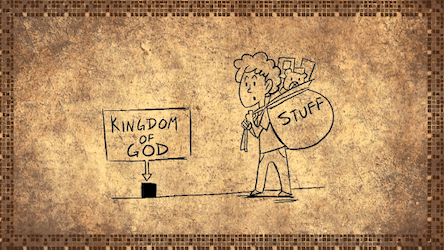
One of the most frequently cited vocation model parables is the encounter which the Gospels give us between Jesus and a promising candidate. I say “promising candidate” because the man who runs up to Jesus and asks what might very well be thought of as the key question for anyone who is serious about living this life to get to the next life, is a man with great faith credentials, and great faith practice credentials. But the Gospel story is not just as simple or straightforward as we would like it to be. That said, it does offer ample opportunity to think about the dynamic of vocation discernment, and so we should consider it.
Firstly, a little clarification. Almost without really thinking about the words which come out of our mouths we tend to refer to this story as The Rich Young Man. Now, that is only partly true. In the Gospel according to Matthew it certainly is the case: the man who approaches Jesus and questions him is indeed referred to as “a young man”, twice, in fact (Matthew 19:20, 22). Matthew has also added and changed a few other details – the young man asks what good deed he has to perform to possess eternal life; and he is careful to say that he has kept all the commands, simply, since he is still in his youth, and so it would hardly make sense for him to say that he has kept them since his earliest days!
Matthew will have had his reasons for his version. Perhaps there was an autobiographical hue to his account…. But I think it bears greater fruit to consider what is regarded as the earlier version of the story, since Mark’s Gospel has long been considered the first of them to have been written, and is rightly felt to be a source document or record for the evangelists Matthew and Luke.
So, let us consider what Mark has to say to us.
The version of this story in Mark occurs in 10:17-22. He places it in a section which sees tension building, and the pace quickening, as Jesus moves towards the defining moment of the Passion. This section in Mark’s Gospel, again and again, asks questions about discipleship, and what it is to become a true disciple. In the middle of all of this a man runs up to Jesus. Perhaps he had been on the fringe of Jesus’ group for a while, even since Jesus had first made his ministry a public one. Since Mark does not tie him down in any way he is a sort of Everyman – he represents all those who are searching and seeking, who have an idea of a direction and a way of life but one which is accompanied by a restlessness, an inability to find a true and satisfying goal. What prompted this man to take such an initiative is not known – but grace must be at work. He overcomes whatever had previously held him back, and he kneels before Jesus.
What is the right time to come forward and engage God in this conversation? From God’s point of view, the conversation is always alive, is always ready to be resumed, has begun long before we were aware that it had begun. God begins it, after all. He has planted the initiative, even though, when the thought, or the desire, or the question arises, we think we have been the author. But we shouldn’t be disappointed that we are not – God is far more pleased that we eventually respond.
When is the right time? The moment that I sense something of invitation, of curiosity, of dissatisfaction with the way I am going and the yearning for something deeper, more challenging, more mature, or in tune with the true self that I am beginning to sense that I am. And who is the true self? The one without the masks and shadows and play acting which happily makes its way for others, but eventually bores me myself, and reveals itself as false and shallow and pointless. The true self acknowledges that life with oneself only, or even with another human companion, is not my way of going. The true self wants to go along the way with the God of Jesus Christ. Yes, in that sense, I am already my true self – but a self waiting to be uncovered, discovered, recovered and rejoiced in. It’s the self which is at home with God, and wants this conversation about the now and the yet to come to begin seriously.
And so the conversation begins.The very opening should delight us. The man who approaches and meets Jesus addresses him as “Good”. On this point, and others like it, hinges a huge swinging door in Mark’s Gospel. For much of his text, the Evangelist has Jesus encouraging his disciples not to reveal his identity, while Mark himself litters the text with clues and affirmations about this same identity! This is one such moment – and Jesus himself affirms: “Why call me good? No one is good but God alone” So now we know, and the rich man, and all around should know – it’s quite right to call Jesus “good”, because the title, if we call it that, belongs to him – as God. So the rich man is in conversation with God, the God who knows everything about him, but still wants to hear about him from his own lips.
From the point of view of vocation this seems like an absolute shoe-in! This man has kept all the commandments from his earliest days. This, by the way, is noteworthy, and one of the reasons why Mark does not fix this man age: if he has kept all the commandments since his earliest days then there is every probability that he is far from young. And if he is far from young, and has kept all the commandments, and is now looking for something else which will gain him eternal life, then he is stuck. He is not moving in any direction. It has been, one might say, a safe, unchanging, habituated, repetitive life, without challenge, without direction, without growth …. Perhaps, then, he is in a sense “young”, but not in a chronological way. This is a man who has faithfully (which is great) kept all the commandments but they don’t seem to have gotten him anywhere. This man’s faith is not young – it is immature, it has never grown up, it has never become the faith of a man who is truly a disciple. He is stuck in his being observant, and this, eventually, has made him yearn for something more.
Did Jesus wonder: is this guy too good to be true? Too faithful? Too much “the finished article”? Perhaps we would, but Jesus does not. He looks steadily at the man and loves him. He fixes a gaze on the man which says” I know you, deeply and really, I know you are struggling with this faith and what to do and how well you should do it (perfectly?), I know you want something else which will open up this relationship with God, whom you love”. God loves the one who searches for him!
Jesus’ request is an extreme one. Perhaps there is something of the exaggeration in this phrase, which we have taken as the epitome of self-abnegation and the truest and most complete form and expression of discipleship. It does speak to us of a complete renunciation of all that one has, but perhaps is not the complete renunciation which the Passion will reveal, and this, after all, becomes the true model of Christian discipleship – how I most fully and completely icon Christ. That said, the renunciation of riches ( and what are they for each of us?) is the radical beginning of discipleship, it’s the sine qua non foundation, and the first criterion proving the serious commitment of the serious seeker. It asks a lot of each of us. It’s a complete request, not a partial off-loading.
But much more importantly, the request made by Jesus is one which signals a shift in control. Up until this point the rich man has been in control. He is the one who has chosen to live the commandments which his Jewish faith has laid out if he wishes to attain perfection as a good and practising Jew. But it has been all his doing, and his choice. Now Jesus says to him: this is the balance shifting to me, and this is what I ask if you want to follow closely. If you want this life which you are leading and which is stuck, ground to a halt, to gain new dynamism and impetus, let me take control.
This is not to say that the rich man is suddenly passive in all this. And his response demonstrates this: he refuses, he pushes back, and goes away. He is suddenly confused, and wants the control that he has had to remain, to keep what he has, and remain stuck. Had he chosen to go with Jesus, then the control would undoubtedly have been a shared collaboration – God delights in the one who works with him!
Perhaps the most anguished part of this piece is the man’s terrible change in mood: his face fell and he went away sad. This isn’t merely an emotional response or reaction to the encounter with Christ. This is a deep, existential sadness, crushing, gutting, emptying. It is joyless. He goes away – from God – back to what he had previously known. We don’t know what became of him. Perhaps there was another moment, which came after more reflection, an increasing sense of his own sadness away from God in Christ, and that in itself would have been the desire to come close to God rekindling.
Gerard Hughes, in his splendid book God of Surprises, presents the reader at one point with a list of contrasting marks of true repentance and false repentance. Reading them, we might just as well see them as marks of true transformation, true conversion – or true vocation discernment. We often ask ourselves – how do I know that God is calling me to a particular way of life, a particular service in the Church? We hanker after confirming signs, so unsure are we of ourselves and our trust in the God who calls us, loves us, cares for us! We all need signs – they comfort, as well as confirm. So, with a little tweaking of terminology, here are some signs of a true vocation, which might be said to have us remain with Christ, overwhelmed by joy and with face lifted up, and not going away with face cast down and sad.
True vocation discernment frees from self-preoccupation because our trust is in God’s goodness working in us. In his light we see our darkness.
True vocation discernment brings joy and inner freedom.
True vocation discernment can welcome criticism and learn from it.
True vocation discernment brings understanding, tolerance and hope.
True vocation discernment brings compassion and therefore a sharpened sensitivity to all forms of injustice.
True vocation discernment shares God’s laughter and frees the mind to see the humour of all situations.
In true vocation discernment a person feels drawn to God.
– Part of our ‘Vocation’ series –
Other posts..
 Our Lady of Bethlehem Abbey, Portglenone