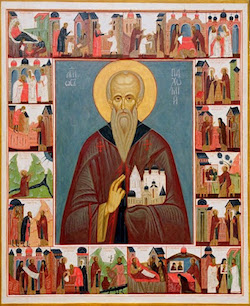
Towering over the emergence of monasticism in the early Church are two figures who represent the complementary aspects of monastic living, and which create a natural tension but not the exclusivity of exclusion: St Antony of Egypt, often called the Father of Monks, leads the way into the eremitical monastic life, that which prefers solitude above all, and the saint whose memory we keep on the 15th May, St Pachomius, whose life and teaching are received as the origins of cenobitic, or community, monastic living
Pachomius (292 – 348), an Egyptian who appears to have been born of pagan parents, made an immediate impact with the story of his life, and his monastic foundations, on the fabric of developing Christianity. And indeed the very rich accounts of his life which have come down to us – at least three separate Lives of Pachomius survive and have been the subject of much scholarly work and research – provide, in many ways, received wisdom about the shape which monastic life was taking, and the preferred shape which it would adopt over successive centuries. While the discipline and extreme ascesis of the solitary life in the desert of Egypt – so much held up by the tradition of the Egyptian abbas and ammas – seemed to become the gold standard, as it were, of Christian life based on radical renunciation, the cenobitic life, which saw the monastic life based in and unfolding in a community setting, was to become, by far, the more accepted way of renunciation for the sake of the Gospel.
Pachomius’s model of life begins, from our perspective, with his unlooked for conversion. Conscripted into the Roman army of Constantine the Great, ostensibly to fight a war against advancing enemies of Rome, Pachomius finds himself and his companions being transported toward a theatre of war, and momentarily housed in a prison before the final leg of the journey. This is no surprise – as a conscript Pachomius was mere battle fodder, another body to be heaped into the path of an enemy. Given the grim context of his conscription and its almost incontrovertible conclusion, escape might have seemed by far the best option. But the Romans took no chances with their conscripts, and so a prison was the necessary holding centre.
“When they arrived at Ne, capital of the ancient empire, the men were brought into the city and thrown into prison. In the evening some citizens of that city brought bread and victuals to the prison, and they compelled the recruits to eat, because they saw them sunk in great affliction. When young Pachomius saw them, he asked the men who were with him, ‘Why are these people so good to us when they do not know us?’ They answered, ‘They are Christians, and they treat us with love for the sake of the God of heaven.’ He withdrew to one side and spent the whole night praying before God saying, ‘My Lord Jesus the Christ, God of all saints, may your goodness quickly come upon me, deliver me from this affliction and I will serve humankind all the days of my life.’”
The Bohairic Life of Pachomius
With the war at an end, and freedom granted to conscripts, Pachomius makes his way south again and settles in a rather deserted place, where he hears the voice of the Spirit: ‘Struggle and settle down here.’ His desire for a life lived in God’s presence allows him to enter into dialogue with his visitors, who begin to gather around him, and he finally receives baptism and becomes a Christian. But the increasing crowd, and his deep desire to seek God, move him, as it has done and continues for many others, to step aside again and seek after greater solitude.
“After three years in that place, he realised that he was surrounded by many people to the point of being much inconvenienced, for they would never let him have a moment’s peace. Then he sought to become a monk and to give himself up to the anchoritic (that is, eremitic) life. While he was thinking of moving away from that place for this purpose, he was informed of an old man, an ancient ascetic called Apa Palamon. He was a great monk who had settled a little way from the village and had become a model and a father for many in his vicinity.”
The Bohairic Life of Pachomius
The gradual move towards monastic life, and Pachomius’s trying on of its various sizes should come as no surprise. Nor indeed should the initial attraction to the solitary life. Often the zeal of beginning can be overwhelming and may push us to the more extreme expressions of our interior life. It does not mean that such an expression or desire is misplaced or mistaken – on the contrary, it is a valid step on the journey of discernment: what model of life am I called to, and will I settle in? Undoubtedly, God allows us to search out the ways which lie before us, and which he opens to us, so that, surrendering at last to his plan, we can put aside our own overwhelming desires in order that he draw us gently into his desire for us.
What is essential here is that Pachomius, having rather guided himself in his search, now places himself under the direction of another, one whom he knows is practised in the lived experience of the monastic way. Pachomius realises that he must be the student, the disciple, under the direction of the teacher and master. This first step is indispensable: humility flavours our thought and discernment and allows us to see that another has the beginnings of answers for me in my search, and the tools which I need to keep searching profitably. The relationship of teacher and disciple marks all great monastic living.
In the midst of that initial meeting between Palamon and Pachomius – conducted out of a window, since Palamon wishes to demonstrate that even entry into the monastic life is difficult and requires repeated demonstrations of perseverance and patience – Palamon gives an essential truth to his soon-to-be student: ‘We are commanded to pray without ceasing, and it is also written, If anyone of you is in trouble, let him pray. Our Lord Jesus Christ likewise commanded his disciples, Pray so as not to enter into temptation. Prayer is indeed the mother of all the virtues.’
Prayer is the mother of all the virtues. For St Benedict, discernment is the mother of all virtues, but we can be sure that he would not wish it to be seen nor recommend its priority without its proper context – prayer. Since true prayer is that ceaseless standing in God’s presence, with the mind fully united to the heart, it provides the only trustworthy seedbed for coming to know what is God’s will,which is the very object of Chrstian discernment. Still, Palamon – and Pachomius – drum on the heart of monastic existence: if its entire project does not find its foundation in prayer then it will not be a mirror of God’s will.
Needless to say, Pachomius entered into discipleship with Palamon, and progressed in the monastic life of ascesis, prayers, fastings, work and vigils.
The summit of Pachomius’s life and influence as monk comes with his realisation of the monastic community according to his own model. The Koinonia – and the term is, according to the lives, his own choice from Acts – develops for Pachomius as a regimented and disciplined way of committed life, and, with its focus on community living and fellowship, a definite move away from the solitary, anchoritic life which had held sway until then. Koinonia needs not a little explanation. It occurs most prominently in the Acts of the Apostles when the sacred author attempts to describe not just the life of the early Christian community but its style, we might say, its culture, its particular hue and feel. This is summed up by the koinonia – not community alone, but brotherhood, fellowship, communio (to use the characteristic Cistercian term), sharing of common things:
These (converts) remained faithful to the teaching of the apostles, to the brotherhood, to the breaking of bread and to the prayers. The many miracles and signs worked through the apostles made a deep impression on everyone. The faithful all lived together and owned everything in common; they sold their goods and possessions and shared out the proceeds among themselves according to what each one needed. They went as a body to the Temple every day but met in their houses for the breaking of bread; they shared their food gladly and generously; they praised God and were looked up to by everyone. Day by day the Lord added to their community those destined to be saved.
Acts 2:42-47
And a little farther one:
The whole group of believers was united, heart and soul; no one claimed for his own use anything that he had, as everything they owned was held in common.
Acts 4:32
Taken together, these two brief but tightly redacted passages lay out the essentials of this new community, this Koinonia, formed around the apostles, with the memory of and preaching about the Risen Christ at the centre, in a style of living which emphasis a new degree of unity and sharing in things held in common, especially the prayer of the community, the bedrock of the apostolic teaching, the worship act which is breaking of bread and is thus a new and distinguishing prayer action marking this community’s approach, all of which illustrates a fellowship borne out primarily in sharing according to need and participation which illustrates fundamental equality. And it is this, taken all together, which begins to constitute the new and potent reality of Koinonia – the sharing in things held in common which constitutes a communion.
And this was, above all, Pachomius’s genius as he received the Word of God and his own monastic call and established this new way of living, fully resonant with the example of the early Christian community. This mark of Koinonia, and its direct and deep dependence on the model established in Acts, becomes the enduring model for most monastic living, and monastic reform, from this point onward.
If we are to reap some harvest from the rich accounts of the life of Pachomius which have come down to us, a number of always relevant aspects present themselves to us. And they can be applied with considerable force today as we reflect on the changing face of encounter with and discernment of vocation, the specific vocation to monastic life, and the context in which all that important personal work unfolds.
The conversion story of Pachomius has, at its core, a moment of encounter and revelation. He finds himself in a situation of great need and a certain loss of personal freedom and autonomy – he is forced to rely upon the ministries of others, and it’s their support, essentially unlooked for and unimagined from Pachmius’s standpoint, which proves pivotal for him. The charity without cost touches him profoundly. Others, without asking for any payment in return, give what they have to those who are in greatest need, Pachomius and his fellow prison conscripts. What is quite arresting is the reason given for their charity and service – it is because they are Christians. Immediately, the disposition toward the other in need, the willingness to seek out and serve those who are marginalised and imprisoned, and the way in which this service is undertaken is not merely an attitude of philanthropy but a distinguishing feature of those who follow Christ and are called Christians. Pachomius is able to see at first hand those who very lives reflect what they are called, and this has a transformative effect on his own life’s direction. Indeed, it invites him to consider the gift and renunciation of all that he had hitherto known to seek out and embrace a monastic way of life. The powerful influence of another on ourselves, who by a word or act can redirect us in our life choice and discernment, should never be underestimated. And likewise, we must measure how we influence others, for good and bad, in their own choices.
The influence of the other, as guide, or lived example, or signpost redirecting our feet onto the right path, becomes, in a sense, the core theme of the life of Pachomius. Having achieved his conversion, and baptism, and made a beginning of a monastic life, he realises that he cannot journey alone: he must seek out the wisdom and support of another who is known to be practised in monastic living and virtue and so can become his teacher. This relationship is pivotal and indeed indispensable in any Christian way of living – because it mirrors the Christ-disciple relationship. It stands at the centre of that body of Sacred Scripture which also found a particular resonance with monstics – Wisdom literature. So, the neophyte, driven by desire, recognises the need for a teacher. And not one who can communicate the essential information about the life and its purpose, but who has so lived it that it is evident that the encounter with God is all that counts. The teacher lays out the experience of his own life as the experience of life with God – this makes his teaching authentic, and so immediately attractive and convincing for the serious seeker.
This is also a beginning in that most monastic, and yet also most Christian, way of flavouring and leavening life – the way of humility. Humility provides a lens through which clearer vision of oneself and one’s relationship with others and God can be properly viewed and judged. It hangs upon a sort of transparency – things are seen more clearly the more the light of humility shines through, but in such a way that humility itself isn’t, and probably shouldn’t be noticeable. We don’t live to acquire humility in itself – it would be rather pointless. But humility flavours the life of the Christian, giving it its distinctly Christ-like quality. Rather like salt, it’s not much use to anyone until it is combined with food and begins its own, sharpening work, or used with water to clean effectively. So it probably was with Pachomius – many virtues can be lived from a purely human point of view, and do a great deal of good for those who are recipients. But virtues flavoured with humility have the potential of becoming means by which Christ is experienced, and that is foundational for the Christian who wishes to take the Gospel to heart in a radical fashion.
Needless to say, the matter of monastic life in community lies at the heart of Pachomius’s story for us today, as it must have done for our predecessors who knew his history. Perhaps more than ever today the desire for belonging in a community which offers the context for one’s identity search to be made real seems uppermost in the desire of a new generation. For all the apparent confidence of the generation which embraces so-called Millenials and the newest grouping of Gen Z, knowing what community and communities I belong to has never been more talked about. Has it something to do with the apparent collapse of community identities and structures and institutions whose existence and apparent unshakeability had been taken for granted for so long? Probably, in part. The rejection of established community affiliation has become almost de rigeur – and not without fault on the part of those institutions and communities – but the growing instability and unrootedness of today’s rising young generations cannot be overlooked. There is a desire to belong to something, but a resistance to belonging definitively to anything which might imply being tied down for too long.
Does Pachomius’s Koinonia – the fellowship of commonality and sharing which provides more than merely physical togetherness and support – have something to say to us today? Even for those who are already well bedded into monastic life something can be found. The regularity of the life, with its simple but well proportioned structure, offers, as most who live it will tell you, a paradoxical sense of freedom rather than the horror of being tied down and constantly told what to do. Not having to think about what’s next, until you hear the monastic bell calling you to the next community prayer time, or meal, or meeting, is a very liberating and liberated way to live: the task at hand, the Office at Choir, or the slow and appreciative eating of a simple meal is really all that must command one’s attention. So, the famous idea of living in the moment – in the hic et nunc, as Latin has it, the here and now – suggests itself as a fairly fundamental attitude to disciplined monastic life. And the very fact that you are living this in concert with a bunch of others who at least give the impression that they are somewhere on the same page as you can do much to lift a flagging spirit or one who has been made desolate or disconsolate by personal failures or struggles.
Pachomius’s Koinonia community had the feeling and model of a military cohort and camp – and that, of course, stemmed undoubtedly, from his own experience. Perhaps it was a little too regimented, and that might account for the fact, soon after Pachomius’s death, the Koinonia quickly folded – the structure was too wieldy to maintain, and the whole enterprise, even though it had trusty successors in place, lacked the initiative and drive of the Founder. That said, regulating monastic life was established as a norm, and over the next few centuries would find several important expressions, not least of which would be the Rule for monasteries left by St Benedict of Nursia.
-Part of our ‘Celebration of the Saints’ series-
Other posts…
 Our Lady of Bethlehem Abbey, Portglenone